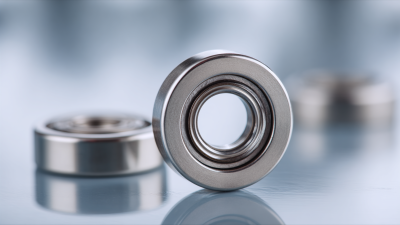
When it comes to choosing Brake Bearings, global buyers aren’t just looking for a familiar name—they want confidence that the part will perform reliably, come with clear specs, and be easy to source across different markets. Sure, a bearing might seem tiny, but it’s doing some pretty heavy lifting—handling heat, vibrations, moisture, and repeated pressure in braking systems.
Details really do matter here. Experienced buyers will dig into things like load ratings, tight tolerances, sealing design, the quality of materials, and lubrication needs. They also ask for inspection reports, batch numbers, and practical test results before they sign off on a supplier. All of this helps avoid installation headaches and unexpected maintenance headaches down the line.
And let’s not forget—fit comes first. Reliable manufacturers are open about their production capacity, lead times, packaging, and quality checks. They should be able to explain how each Brake Bearing model is suited for specific vehicles, machines, or environments. Good technical support is just as crucial, especially when someone’s puzzling over metric vs. imperial sizes, different seal materials, or temperature variations.
Don’t put all your trust in a shiny catalog—that’s just a starting point. Even seasoned teams can overlook issues like corrosion risks, wrong preload settings, or incompatible grease. That’s why testing samples and gathering feedback from actual field use is so valuable. A supplier who’s willing to answer questions and admits their products’ limitations shows true professionalism, instead of just promising perfect performance everywhere.
On the global buying side, documentation is also key. Things like detailed drawings, test reports, labeling, and shipping records need to match the goods you receive. This makes tracking things easier and helps everyone—from manufacturers and distributors to end users—stay on the same page.
So, when it comes down to it, Brake Bearings aren’t picked just based on price. Buyers look at real evidence, past service experiences, and how reliable the parts will be over the long run. The smartest decision combines solid technical review with honest considerations about real-world conditions. That way, global buyers can forge safer, more dependable supply chains that stand the test of time.
Brake bearings support the wheel hub, brake rotor, and wheel assembly. Their job is simple but demanding. They carry radial and axial loads while the hub rotates near heat, water, and road dust. In practical inspections, rough rotation often appears before serious noise. It may feel like a faint sandpaper drag.
Common designs include deep-groove ball bearings, tapered roller bearings, angular-contact bearings, and integrated hub units. Tapered rollers handle combined loads effectively. Double-row angular-contact units save installation space. The International Energy Agency reported nearly 14 million electric car sales in 2023, representing about 18% of global car sales. Heavier electric vehicles can increase hub loading, although vehicle design still matters more than propulsion type. Do not treat one bearing type as universally superior.
ISO 492:2014 defines dimensional and running-accuracy tolerances for radial rolling bearings. P0 is the normal tolerance class. P6 and P5 provide progressively tighter accuracy. These classes affect bore size, outside diameter, width, and runout. A tighter class can improve fit, but it cannot repair poor machining or incorrect preload. That point is easy to miss.
Tips: Check the load direction, sealing condition, clearance, and mounting method together. Match ISO 492 tolerances with the hub drawing, not only the catalogue number. Measure the seat. Small errors can create heat, vibration, and premature wear. I would also review real duty cycles, because laboratory ratings rarely mirror every road.
Why Choose Brake Bearings for Global Buyers?
Capacity must come before price. The IEA Global EV Outlook 2025 reports over 17 million electric cars sold in 2024. Heavier vehicles and blended braking can change bearing loads. Friction braking may occur less often, but each event can still create sharp radial and axial forces. Buyers should request load spectra, not only a maximum load value.
ISO 281:2007 provides the basic L10 rating-life method. For ball bearings, L10 = (C/P)^3 million revolutions. C is the basic dynamic load rating. P is the equivalent dynamic bearing load. For roller bearings, the exponent becomes 10/3. Suppose C equals 50 kN and P equals 10 kN. The calculated ball-bearing life is 125 million revolutions. At 600 rpm, that equals roughly 3,472 operating hours. This is a calculation, not a promise.
Brake applications need more than a clean spreadsheet. Temperature, contamination, mounting errors, vibration, and repeated emergency stops can reduce real life. ISO 281’s L10 value represents 90% reliability under defined conditions. It does not fully capture every brake-load shock. In practical testing, engineers should combine duty-cycle data, thermal measurements, and vibration results. Our first estimate is often too optimistic. That is worth questioning. Global buyers can then compare capacity, sealing performance, and documented test evidence on the same technical basis.
Why Choose Brake Bearings for Global Buyers?
Speed and Heat: Check SAE J328 Wheel-Bearing Test Requirements
Brake bearings support the wheel hub under changing loads, speed, and heat. Their performance affects noise, service life, and driving stability. Global buyers should examine SAE J328 test evidence before comparing prices. The standard focuses on wheel-bearing performance and endurance under controlled conditions. Test programs may include rotational speed, radial load, axial load, lubrication, and temperature monitoring. Requirements can depend on the bearing type and test revision.
Heat tells a deeper story. During testing, technicians watch temperature rise near the raceway and seal. A bearing may feel smooth at room temperature, yet become noisy after repeated high-speed cycles. That difference matters. Buyers should request the test speed, applied load, grease specification, temperature records, and inspection results. They should also confirm whether the laboratory used the correct SAE J328 revision. A certificate without method details is weak evidence.
No test is perfect. A passing result does not guarantee equal performance in every vehicle. Road dust, poor installation, misalignment, and incorrect preload can change the outcome. Practical buyers compare test data with dimensional checks and material records. They also review failed samples, not only successful ones. That uncomfortable detail often reveals weak sealing, abnormal wear, or cage damage. Reliable suppliers explain such findings clearly and provide traceable quality records.
| Buyer Evaluation Dimension | Relevant Wheel-Bearing Test or Specification | What the Test Measures | Key Data to Request | Why It Matters for Brake Applications |
|---|---|---|---|---|
| Standard Reference | SAE J328, Wheel Bearing Performance and Test Requirements | Performance requirements and test methods for automotive wheel-bearing applications under defined operating conditions. | Standard edition, applicable bearing type, test configuration, load condition, speed condition, lubricant, and acceptance criteria. | Confirms that supplier test results are linked to a recognized automotive wheel-bearing performance framework rather than only to an internal factory test. |
| Rotational Speed | Speed or endurance test under a specified rotational speed and load | Ability of the bearing to rotate continuously without unacceptable noise, seizure, abnormal wear, or loss of function. | Test speed in r/min, test duration in h, applied radial and axial loads, starting and final condition. | Brake-system components operate at changing wheel speeds. Speed capability helps reduce the risk of overheating, vibration, and premature bearing damage. |
| Temperature Capability | Temperature monitoring during speed, load, and endurance testing | Bearing outer-ring or housing temperature behavior under a defined operating cycle. | Ambient temperature, measured bearing temperature, temperature rise, stabilization time, maximum recorded temperature, and test duration. | Excessive heat can reduce lubricant life, accelerate seal aging, alter internal clearance, and increase the risk of early failure. |
| Heat Resistance | Thermal endurance and repeated heat-cycle evaluation | Resistance to repeated heating and cooling while maintaining rotation, sealing, lubrication, and dimensional stability. | Number of heat cycles, upper and lower temperature points, dwell time, cooling method, post-test inspection results. | Brake heat is transferred through the hub and surrounding components. Thermal cycling is therefore relevant to vehicles used in heavy traffic, mountainous regions, and high-load service. |
| Applied Load | Radial load and axial load defined by the test setup | Durability under forces acting perpendicular and parallel to the bearing axis. | Radial load in N, axial load in N, load ratio, loading direction, and load application method. | Wheel bearings experience vehicle weight, cornering forces, road impacts, and braking-related loads. Speed data without load data is incomplete. |
| Lubricant Performance | Specified grease type, quantity, and lubrication condition | Effect of the lubricant on friction, heat generation, wear, noise, and service durability. | Grease base type, thickener type, operating temperature range, fill quantity, compatibility information, and relubrication condition. | Incorrect grease selection or quantity can raise operating temperature and may reduce bearing life, especially during sustained high-speed or high-load operation. |
| Seal Protection | Sealing performance under rotation, temperature, and contamination exposure | Ability of the seal system to retain lubricant and limit entry of water, dust, and road contaminants. | Seal design, sealing material, temperature exposure, contamination medium, leakage observation, and post-test seal condition. | Water and abrasive particles can contaminate grease, increase friction, and create raceway damage that later appears as noise or vibration. |
| Friction and Torque | Rotational torque or running-resistance measurement | Resistance generated by the bearing during rotation at a defined speed, load, and temperature. | Starting torque, running torque, measurement speed, applied load, temperature, and allowable variation between samples. | Lower and more consistent running resistance can support thermal control and reduce unnecessary energy loss, provided durability and sealing requirements are maintained. |
| Noise and Vibration | Acoustic, vibration, or roughness inspection after and during testing | Abnormal bearing sounds, vibration levels, surface damage, and running irregularities. | Measurement method, frequency range, vibration value, noise observation, test speed, and post-test raceway inspection. | Bearing surface defects may become audible or produce vibration before complete failure, making these checks useful for quality screening. |
| Dimensional Compatibility | Geometric and mounting verification | Compatibility of the bearing with the hub, axle, seal, retaining system, and related brake hardware. | Bore diameter, outer diameter, width, flange dimensions where applicable, tolerance class, internal clearance, and mounting direction. | Correct dimensions and tolerances help prevent installation stress, misalignment, uneven loading, and abnormal heat generation. |
| Material and Hardness | Material certificate and heat-treatment inspection | Conformity of rings and rolling elements with the specified bearing steel and hardness range. | Material designation, hardness result, heat-treatment process, metallographic inspection, and certificate traceability. | Material and heat-treatment consistency influence fatigue resistance, wear behavior, and the ability to withstand repeated wheel loads. |
| Post-Test Acceptance | Visual, dimensional, functional, and teardown inspection | Whether the bearing remains functional and free from unacceptable flaking, cracking, seizure, excessive wear, lubricant loss, or seal damage. | Acceptance criteria, inspection photographs, dimensional change, raceway condition, rolling-element condition, seal condition, and final torque or noise result. | A complete post-test record helps global buyers compare suppliers using evidence instead of relying only on a nominal speed or temperature claim. |
| Test Traceability | Controlled laboratory record aligned with the applicable standard revision | Reproducibility and credibility of reported test results. | Sample identification, batch number, equipment calibration status, operator, test date, raw data, deviations, and signed test report. | Traceable records simplify technical approval, incoming inspection, warranty analysis, and communication across international supply chains. |
Note: SAE J328 test conditions and acceptance limits depend on the bearing design, vehicle application, loading arrangement, lubricant, and applicable standard edition. Buyers should confirm the exact requirements in the current controlled copy of the standard and in the approved product specification.
Brake bearings face repeated loads, vibration, heat, and occasional moisture. Their steel quality directly affects noise, friction, and service life. ASTM A295 defines requirements for high-carbon anti-friction bearing steel, commonly used for rings and rolling elements. ISO 683-17 addresses ball and roller bearing steels within an international technical framework. These standards overlap in purpose, but they are not automatically interchangeable.
A careful buyer should compare chemical composition, hardness, heat treatment, cleanliness, and delivery condition. Ask for the exact steel grade, not only “bearing steel.” Mill certificates should match the heat number on the material. Inclusion control deserves attention. Small non-metallic inclusions can become fatigue cracks under repeated braking cycles. Ultrasonic inspection may add useful evidence for larger sections.
Certification alone is not enough. A document can look complete while missing critical heat-treatment details. That is where purchasing decisions become less comfortable. Request spheroidized annealing records before machining, then verify final hardness after quenching and tempering. Dimensional stability also matters when a bearing operates beside a hot brake assembly. ISO 683-17 may suit a buyer requiring internationally structured requirements, while ASTM A295 can support projects built around ASTM documentation. The correct choice depends on the drawing, test plan, and operating temperature. I would also check how the supplier controls batch traceability, because one unidentified lot can weaken an otherwise reliable quality system.
Global buyers should judge brake bearings by contamination control, not price alone. Road spray, grit, salt, and repeated heat cycles attack the seal. A small lip gap can become a path for moisture. Grease then loses consistency, corrosion begins, and torque rises.
The U.S. Department of Energy’s Motor Systems Market Assessment reports that bearings cause about half of motor failures. Brake hubs are different, but the warning remains useful. ISO 281:2007 calculates rating life from load and speed. It does not promise service life in dirt or water. In practice, seal design and grease fill may matter more than a higher static load rating. Request water-ingress tests, temperature data, and grease compatibility. NLGI grade alone is not enough. Over-greasing can increase heat. I may be too cautious here. Laboratory results rarely mirror winter roads, potholes, and imperfect installation.
Why Choose Brake Bearings for Global Buyers?
In practical supplier reviews, quality begins with evidence, not attractive samples. Ask whether the IATF 16949 certificate covers the actual manufacturing site and relevant bearing processes. A certificate alone proves little. Check its issuing body, validity, scope, and recent audit status.
PPAP files should match the supplied part number and revision. They should include dimensional results, material certificates, process flow, control plans, PFMEA, and measurement-system studies. Review capability data for critical dimensions, such as raceway diameter and flange runout. Small gaps matter. A missing approval signature may reveal weak document control. Buyers should also compare PPAP records with production samples, packaging labels, and inspection equipment used on the line.
Traceability must work backward and forward. A bearing’s lot code should connect to steel heat records, operator shifts, grinding records, lubricant batches, inspection results, and shipment documents. Request a controlled traceability exercise using one finished unit. Can the supplier identify affected lots within hours, not days? This test often exposes practical weaknesses. Some suppliers maintain excellent paperwork but cannot link subcontracted heat treatment to the final lot. That deserves a corrective action plan. Keep clear records of findings, agreed deadlines, and verification results. Reliable suppliers welcome these checks because they reduce uncertainty across borders, warehouses, and service applications.
Why Choose Brake Bearings for Global Buyers?
Global-Buyer Scorecard: Compare TCO, Incoterms, and Regional Compliance
Brake bearings should be judged by total cost of ownership, not unit price alone. A cheaper bearing can create higher costs through early replacement, downtime, or complex claims. UNCTAD reports that maritime transport carries over 80% of global trade by volume. Freight planning therefore matters. Compare ocean, air, insurance, handling, duty, and inventory costs before approval. FCA can improve buyer control over freight. DDP may simplify purchasing, but import responsibilities and local tax treatment need careful review. Incoterms do not replace a complete supply contract.
Tips: Build one landed-cost sheet. Include delivery risk, inspection fees, and warranty exposure. Ask suppliers for batch traceability, dimensional reports, material records, and test evidence. A spreadsheet is useful. It is not perfect.
Regional compliance can change the buying decision. European projects may require chemical and material declarations under REACH or RoHS-related requirements. North American applications may require evidence supporting applicable vehicle and brake-system regulations. Local certification, labeling, and documentation rules should be checked before shipment. The World Bank’s Logistics Performance Index 2023 shows meaningful differences in customs, infrastructure, and shipment reliability across markets. That gap affects safety stock and delivery promises.
Experienced buyers also compare failure data, not only catalog specifications. Review seal performance, load ratings, temperature limits, and installation controls. We sometimes overvalue polished certificates. Independent verification is wiser. A regional compliance review, completed before purchase, can prevent an expensive rejection at the destination.
It evaluates bearing performance under controlled speed, radial load, axial load, lubrication, and heat. Temperature matters. Technicians monitor the raceway and seal areas during repeated cycles.
Request test speed, applied loads, grease specification, temperature records, inspection results, and the exact standard revision. A certificate without method details is weak evidence. I would not accept it alone.
Real vehicles face road dust, misalignment, poor installation, and incorrect preload. These conditions can increase noise and wear. Testing is useful, not perfect.
Check the exact steel grade, chemical composition, hardness, cleanliness, heat treatment, and delivery condition. “Bearing steel” is too vague. Ask for the heat number.
Compare composition, hardness, cleanliness, heat treatment, and dimensional stability against the drawing and test plan. These standards can overlap, but they are not automatically interchangeable. The operating temperature also matters.
Request mill certificates linked to the steel heat number. Review spheroidized annealing records and final hardness after quenching and tempering. Ultrasonic inspection may help with larger sections.
Confirm the manufacturing site, bearing processes, issuing body, validity, scope, and recent audit status. A certificate alone proves little. Check the actual factory.
It should match the part number and revision. Review dimensional results, material records, process flow, control plans, PFMEA, and measurement studies. Check raceway diameter and flange runout carefully.
Select one finished bearing and request backward and forward tracing. The lot code should connect with steel, shifts, grinding, lubricant, inspection, and shipment records. Try it within hours. That may expose weaknesses.
Failed samples may reveal weak sealing, abnormal wear, cage damage, or heat-related noise. Successful samples show only part of the story. Uncomfortable, but useful.
Brake Bearings are critical wheel-hub components that support vehicle loads, maintain accurate wheel rotation, and withstand braking forces, vibration, heat, and contamination. For global buyers, selection should begin with capacity: use ISO 281’s L10 life approach to match bearing ratings with real brake loads, duty cycles, and expected service life. Dimensional accuracy and running tolerances should also be checked against ISO 492, while speed and thermal performance should be evaluated through relevant wheel-bearing test requirements such as SAE J328.
Material quality, sealing, and lubrication directly affect durability. Buyers should confirm that steel meets applicable ASTM A295 or ISO 683-17 requirements, and assess seals for contamination control under water, dust, and temperature exposure. Supplier evaluation should include IATF 16949 certification, PPAP documentation, batch traceability, and consistent inspection records. Finally, a practical scorecard should compare total cost of ownership, delivery reliability, Incoterms, warranty support, and regional compliance to identify a dependable long-term supply solution.